
I am happy to share my work with all the blogger readers. I am one of handloom weaver. I would like to share my work with all the readers. Here, we go.......!
For making a handloom sari, we need these requirements:-
1. Good quality of yarn and warp.
2. Fine quality of pure jari.
3. Hand loom structure
4. Limited Premises to fix Hand loom.
5. Big Jacquards for exclusive designer saris.
6. Punched Cards for designs.
7. Well trained Labours to work on.
8. Process of making a sari.
Here, I would like to explain each and every requirement deeply with images and videos. I hope you like my content and give suggestions.


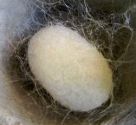
Silk moths lay their eggs on the mulberry leaves, and the worms hatch after fourteen days. The worms feed on the leaves continuously, and they molt as they grow. After molting four times, the larvae enclose themselves in a cocoon of raw silk produced by their salivary glands. Silk is basically a protein consisting of the amino acids glycine (60%), alanine (20%), and serine (20%). Inside the cocoon, a silkworm transforms into a pupa that emerges as a moth in about three weeks. The moths reproduce and die within five days, but in this time the female manages to lay from 200 to 500 eggs to continue the life cycle.
Silk is harvested by dipping cocoons in boiling water to kill the pupa and help unravel the thread. Each cocoon contains a single silk thread that is about 300 to 900 meters long. Silk from China was known to the ancient Greeks and Romans. The silk road toward the west was opened by the Chinese in the 2nd century AD. Large caravans carried huge quantities of beautiful textiles to the coasts of the Mediterranean. Although silk has been displaced from many applications by synthetic fabrics, more than 80,000 metric tons of silk are produced yearly, principally by China and India.


THE PROCESS OF COLORS DYING TO WARP AND PATTU
How to utilize dying warp to make a sari on Handloom:
For making a handloom sari, we need these requirements:-
1. Good quality of yarn and warp.
2. Fine quality of pure jari.
3. Hand loom structure
4. Limited Premises to fix Hand loom.
5. Big Jacquards for exclusive designer saris.
6. Punched Cards for designs.
7. Well trained Labours to work on.
8. Process of making a sari.
Here, I would like to explain each and every requirement deeply with images and videos. I hope you like my content and give suggestions.
The process of getting Good quality of Yarn and Warp:-
Introduction:-
Sericulture, or silk farming, is the rearing of silkworms for the production of silk. Although there are several commercial species of silkworms, Bombyx mori(the caterpillar of the domesticated silk moth) is the most widely used and intensively studied silkworm. Silk was first produced in China as early as the Neolithic period. Sericulture has become an important cottage industry in countries such as Brazil, China, France, India, Italy, Japan, Korea, and Russia. Today, China and India are the two main producers, with more than 60% of the world's annual production.
Here, I am attaching some images which gives you good knowledge on how to make good quality of "PATTU"( In Telugu language).

This is the first stage of silkworm. The food for silkworm is leaves, which is called ..Mulburry. There are many varieties of mulberry trees. Silkworms will only eat the leaves of the white mulberry tree (Morus alba). Silk production, or sericulture, has been practiced in China for at least 5,000 years. Domesticated silkworms are entirely dependent on humans and no longer occur naturally in the wild. Domesticated silkworm moths cannot fly. They have been bred selectively for improving the quality of the cocoon and silk production.
Silk moths lay their eggs on the mulberry leaves, and the worms hatch after fourteen days. The worms feed on the leaves continuously, and they molt as they grow. After molting four times, the larvae enclose themselves in a cocoon of raw silk produced by their salivary glands. Silk is basically a protein consisting of the amino acids glycine (60%), alanine (20%), and serine (20%). Inside the cocoon, a silkworm transforms into a pupa that emerges as a moth in about three weeks. The moths reproduce and die within five days, but in this time the female manages to lay from 200 to 500 eggs to continue the life cycle.
Silk is harvested by dipping cocoons in boiling water to kill the pupa and help unravel the thread. Each cocoon contains a single silk thread that is about 300 to 900 meters long. Silk from China was known to the ancient Greeks and Romans. The silk road toward the west was opened by the Chinese in the 2nd century AD. Large caravans carried huge quantities of beautiful textiles to the coasts of the Mediterranean. Although silk has been displaced from many applications by synthetic fabrics, more than 80,000 metric tons of silk are produced yearly, principally by China and India.
 |
| The silkworm making silk home around itself. |

 | |||
| This is the process how to get silk from silkworms. |
TWISTING PROCESS:-
Twisting is the process of reeling the bundles of yarn to skein lacing. This can be achieved by winding two strands of silk into multi-ply thread. These multi-ply spools are again used to prepare the warp .The end of the raw silk should be tied with cotton thread which helps to find the silk thread end easily during the preparation process for weaving.
A silk warp yarn is made of several single yarns twisted (with a left-hand twist) to the right. Twisting increases the strength of a yarn. Yarns made of reeled-silk threads twisted together are called thrown silk. Twisting is one of the most important steps in the processing of silk yarns and increases the strength of the yarn considerably and creates compression for packaging. Theses packed bundles of silk yarn are then transported for further treatment like dyeing, weaving and various other processes.
Twisting is the process of reeling the bundles of yarn to skein lacing. This can be achieved by winding two strands of silk into multi-ply thread. These multi-ply spools are again used to prepare the warp .The end of the raw silk should be tied with cotton thread which helps to find the silk thread end easily during the preparation process for weaving.
A silk warp yarn is made of several single yarns twisted (with a left-hand twist) to the right. Twisting increases the strength of a yarn. Yarns made of reeled-silk threads twisted together are called thrown silk. Twisting is one of the most important steps in the processing of silk yarns and increases the strength of the yarn considerably and creates compression for packaging. Theses packed bundles of silk yarn are then transported for further treatment like dyeing, weaving and various other processes.


THE PROCESS OF COLORS DYING TO WARP AND PATTU
How to utilize dying warp to make a sari on Handloom:



No comments:
Post a Comment